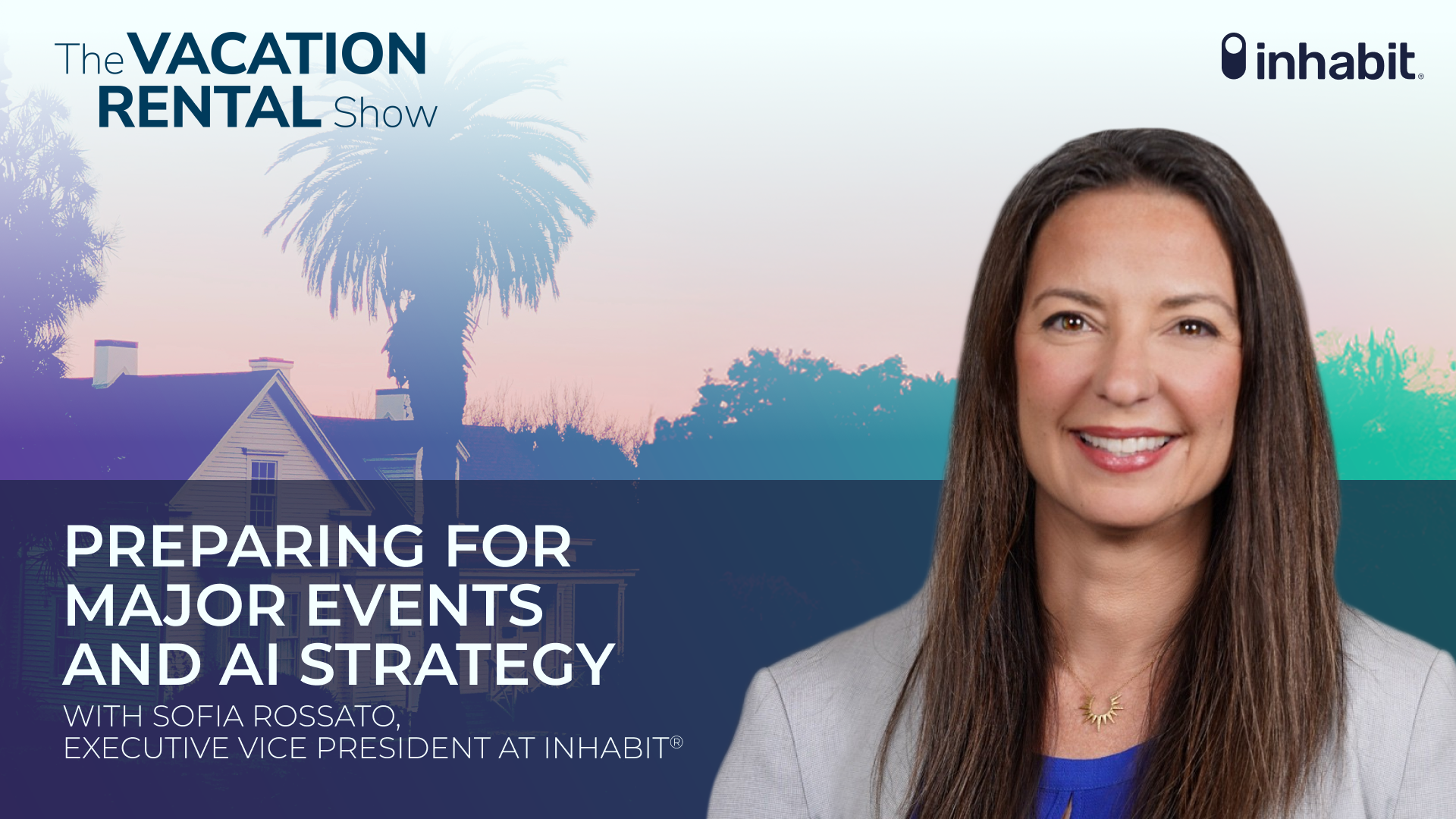
Sofia Rossato joins Lynell Gordon on The Vacation Rental Show to share strategic insights on event-driven pricing, AI implementation, and leadership principles that drive results. As Executive Vice President at Inhabit, overseeing the vacation rental division, Sofia brings a unique perspective from her background managing billion-dollar divisions in fintech and proptech.
From preparing for the 2026 World Cup to implementing AI tools that save hours of work, Sofia offers property managers practical strategies they can use immediately.
This episode is sponsored by Streamline.
Capturing 55% Rate Increases During Major Events
Past mega events, plus in 2026, the forecasts, host cities can expect to see 55% average rate increases versus the prior year. Some of the premium-located units closer to the stadiums can see up to 90%.
Sofia explains that preparation for major events like the World Cup requires action months in advance, not when the announcements are made. Before the host cities were even announced in December, Inhabit put out information through multiple marketing channels about how property managers could prepare. The key is planning ahead and adjusting rates immediately.
Property managers should increase June and July rates now, set three- to seven-night minimum stays, add matchday surcharges, and raise prices for one to two days on each side of events. These are called shoulder event nights. Understanding surge pricing means recognizing that major global events usually range between 40 and 120% rate increases. Units fewer than five miles from stadiums see the strongest spike, but even properties one to two hours away can see a 20 to 60% uplift.
These surges are real, but not uniform—so monitoring your specific market is essential. If you’re not ready to set rates immediately, Sofia recommends blocking those dates to monitor demand and see how others are setting rates. When you’re more comfortable, you can open up the block and set your pricing strategy.
The 300-Mile Zone Strategy for Tournament Bookings
Fans often attend multiple matches in different cities, so promote seven- to nine-night tournament-week stays across multiple locations.
Sofia introduces the concept of using the 300-mile zone as a competitive advantage. Demand radiates out in waves from event locations, and property managers can attract guests even up to 300 miles away or five hours away by focusing on travel time in hours or minutes rather than distance. This is particularly effective for weekend getaways when something special is happening.
Tournament attendees often watch multiple matches in different cities, so promoting seven- to nine-night stays across locations makes sense. Property managers should price short gaps between match days as premium nights because attendees need somewhere to stay. Highlighting airports, transit options, and highways for easy travel becomes part of the value proposition.
As you get further out in those waves from the stadium, affordability compared to stadium-adjacent units becomes the selling point. The strategy shifts based on your location, but there’s opportunity throughout the zone. Even smaller markets outside host cities can capture demand by understanding how fans are planning their tournament experience.
Marketing That Saves Guests Time and Increases Bookings
The number one thing guests want is for you to save them time and to provide these beautiful experiences, but not spend time doing these organizational tasks.
Sofia emphasizes that updating listings goes beyond basic information. For major events, property managers should include stadium travel times by walk, drive, or transit. Clear transit instructions help guests plan their trip. Stadium security policies matter because many stadiums require clear bags or have restrictions guests need to know ahead of time. Parking and entry information removes friction from the guest experience.
Photography should show how beds are laid out for large group sleeping arrangements. TV and internet setup becomes important when guests want to stream matches or stay connected. Interior and exterior parking details help groups coordinate arrival. Maps showing exact proximity to the host city or stadium give guests confidence in their booking decision.
These updates work not just for special events but across the board. They show guests you care enough about them to provide information upfront rather than making them search for it. While some people enjoy planning every detail, most guests want the data readily available so they can make quick decisions and move on to enjoying their trip.
2026 Market Outlook Shows Strategic Opportunities
RevPAR is the number-one metric to look at in unit economics for professional property managers. It’s 16% higher for people using Inhabit products and Streamline.
Sofia shares several macro trends shaping the 2026 market. National occupancy rates for professionally managed short-term rentals rose about 2.5% year over year in January, reaching about 54% versus 51.5% in 2025. The exception is mountain regions where snow has been disappointing this year, but other areas have seen nominal growth.
Average daily rate has held steady from last year. RevPAR, or revenue per available rental, increased 3.2% year over year, driven primarily by higher occupancy and stable rates. What’s particularly interesting is that RevPAR is 16% higher for operators using Inhabit products and Streamline versus other property management systems.
This difference comes partly from more professionalized operations, but also from the ability to create a customized recipe. Streamline allows operators to move all the buttons and configure exactly what they need to win. It’s not one size fits all, so setup takes time, but the finished result is extremely valuable. Many property managers have acquired units from other companies, tested RevPAR before acquisition, and seen immediate uplift after adding them to their portfolio within Streamline.
Value Stays and Portfolio Mix Strategy
Booking windows have reduced, and where they’ve reduced most, value stays become important to capture price-conscious guests making last-minute decisions. However, larger homes with three or more bedrooms are performing better over time. These units have longer booking windows and drive the most revenue for property managers.
Sofia recommends looking at portfolio mix and asset mix strategically. What strategy will you take with smaller units that have shorter booking windows versus larger units that provide better experiences? Some property managers work with owners to test amenities, suggesting pool tables or hot tubs to drive up RevPAR and ADR. Professional property managers are asking what type of units will drive the best economics given their staff capacity, then focusing on those and upleveling them with better amenities.
Leadership Through IDS and Bringing People Along
Bring your people along with you and be a good human. Ultimately, we are in the hospitality industry for a reason.
When asked about leadership advice for property managers, Sofia gets down to the most basic answer after considering the “whys.” Be a good human. Bring your people along with you. The hospitality industry, by definition, requires this approach (even when it’s difficult).
Sofia uses a framework called IDS—identify, discuss, and solve—when meeting with teams. It starts with a team member bringing a problem without trying to solve it. The question is just a question or problem statement, and the entire team comes together to solve it. This is a core tenet in an operating framework called EOS, though Sofia uses pieces from different frameworks to create her own recipe for managing and operating businesses.
Bringing people along in solving problems means you don’t have to have all the answers. When team members help co-create solutions, they’re more invested in executing them. This approach builds ownership and accountability throughout the organization rather than creating top-down mandates that team members will resist or implement halfheartedly.
AI Implementation Made Simple and Actionable
You don’t even have to come up with a prompt. You just have to describe the problem that you’re having. And then it will give you suggestions for a prompt, which then you copy and run.
For property managers just starting with AI, Sofia provides tactical steps anyone can follow immediately. Step one: go to ChatGPT. She recommends disabling data sharing in the settings (otherwise, your data will be shared).
Next, ask ChatGPT to create either the simplest or most advanced prompt to help solve your specific business problem. You don’t even have to come up with a prompt yourself—just describe the problem you’re having. ChatGPT will give you suggestions for a prompt, which you then copy and run.
Keep iterating from there. Treat it like a friend. You can say it can do better, that you don’t like that answer, and explain why. Have a conversation with it. You don’t have to have all the answers. That’s one of the best things about generative AI. It can help you ideate, even ideate the prompt itself. Play with it as an iteration process rather than expecting perfect results on the first try.
Strategic Thinking Time Versus Tactical Firefighting
Sofia observes that paralysis by analysis happens when tactical issues overwhelm strategic thinking time. Property managers deal with fixing toilets, handling emergencies, and responding to immediate needs every single day. This leaves little space to think strategically about the business. The challenge happens in every industry, but Sofia sees it even more in proptech and property management specifically.
Discipline becomes essential. For Sofia, it’s the first hour in the morning before everything starts when her brain is freshest. Whatever strategic thinking you need to move the business forward, even by one percent, should happen then. One percent per day creates compound interest over time. Block off that morning time and leave tactical work for the latter part of the day.
Otherwise, the business runs you instead of you running the business. You work in the business rather than on the business. That early-morning strategic thinking time is when you create systems and build agents. Technology is moving toward verticalization—where a company hires one person to orchestrate agents across functions, rather than hiring project managers, product managers, front-end engineers, and back-end engineers separately—allowing them to generate significantly more revenue with the same number of people. Property managers should consider how AI can help run their business without the need to increase their payroll.
Community Connection Prevents Isolation and Drives Growth
We’re all trying to make the pie bigger. It’s not a fixed pie where we take from each other. The question is: how can we make the pie bigger for all of us?
Sofia emphasizes that property managers can get caught up in day-to-day operations and forget how important community is. Running your own business can feel lonely, especially at the top. Having a community to reach out to for discussion and problem-solving is absolutely key. Inhabit has this in pockets across the ecosystem, and Sofia wants to lean into it even more.
Some closed groups don’t allow vendors or partners, but new communities can be created. Reaching out to peers matters because, as Sofia puts it, everyone is trying to make the pie bigger rather than taking from a fixed pie. The short-term rental industry is still professionalizing itself. Even without the advocacy and lobbying the hotel industry has, short-term rentals have just as many beds as hotels.
There’s huge power in the STR industry. Leaning into advocacy and joining advocacy groups creates another way to build community and keep conversations flowing. The collective strength of property managers working together and sharing knowledge moves the entire industry forward rather than each operator struggling alone with similar challenges.
Conclusion
Sofia Rossato brings a wealth of experience from fintech and proptech to help property managers think strategically about their businesses. From capturing event-driven revenue to implementing AI tools that actually work, her advice focuses on practical steps that create measurable results. The key themes connect: plan ahead for opportunities, bring your team along in solving problems, use technology to work smarter rather than harder, and stay connected to the community that makes the industry stronger.
Whether you’re preparing for the 2026 World Cup or simply looking to improve daily operations, these strategies offer a roadmap. The property managers who succeed are those who create time for strategic thinking, leverage their unique advantages, and remember that being a good human in the hospitality industry isn’t just nice to have. It’s the foundation of sustainable growth.
To hear the full conversation between Lynell and Sofia on The Vacation Rental Show, follow the links below: