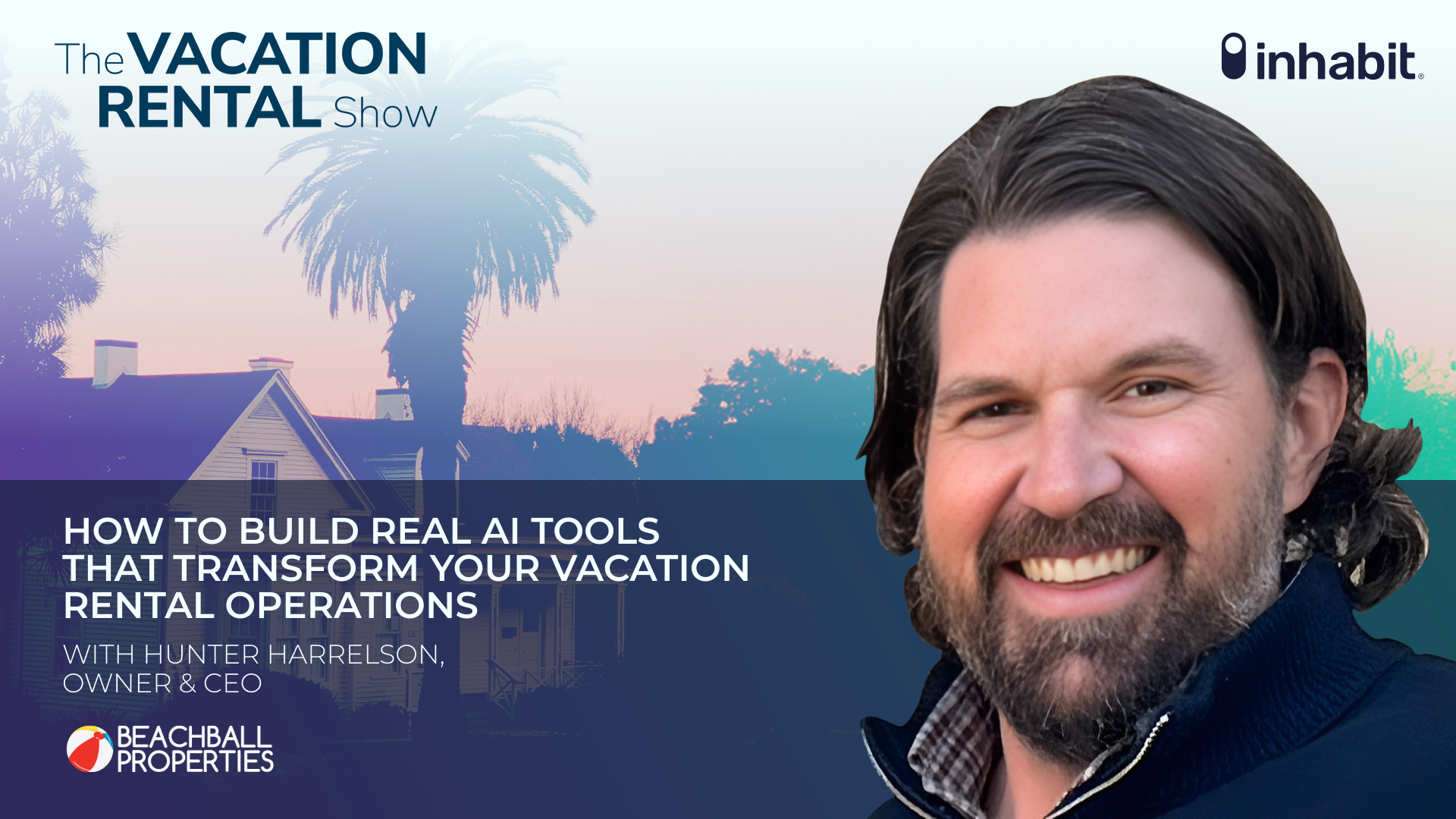
Hunter Harrelson didn’t stumble into the vacation rental industry. He walked in with two decades of financial services experience from Merrill Lynch and Regions Bank, a background in construction from his father’s industrial contracting work, and a wife whose legal training added yet another layer of operational precision. When he and Ginger founded Beachball Properties in 2016, they sold their home, their boat, and cashed in their retirement plans to acquire a 20-property portfolio on the Alabama Gulf Coast. Everything that followed was built on that foundation.
Today, Beachball Properties manages more than 350 properties across Gulf Shores, Fort Morgan, and Orange Beach, and Hunter leads the company as a systems-driven CEO who still looks for ways to improve margins, renegotiate vendor contracts, and solve operational problems with the right tools. In this episode, he shares the frameworks, hiring strategies, and hard-won lessons behind one of the Gulf Coast’s most recognized names in vacation rental management.
This episode is sponsored by Streamline.
Rethinking Customer Service in a Low-Contact Landscape
AI is the buzzword, right? Everybody, everybody’s using AI, but so many people are just using it as a glorified Google search.
Hunter’s thinking on AI was shaped by a conversation during a panel with Steve Schwab, who pointed out a quiet but significant shift in the guest experience. Where guests once checked in face to face and left knowing there was a real person behind the brand, OTAs and the acceleration brought on by COVID changed that entirely. Door codes replaced keys, the human connection faded, and for most guests, the only reason to contact the office at all is when something has gone wrong.
That insight reshaped how Hunter thought about his customer service team. If the only incoming calls are complaints, the team gets beaten down by situations they often can’t control. Training new employees became a cycle that drained time and energy without solving the underlying problem. What his team actually needed wasn’t more documents to search through; they needed a way to get fast, accurate answers in the moment.
Hunter worked with his web developer to build a custom bot using Google’s Gemini platform, connected directly to Beachball Properties’ SOPs. Customer service staff and virtual assistants, including team members working remotely in the Philippines, can ask the bot a natural question and get an immediate answer. When a gap appears, the question gets escalated to management, the answer gets added, and the bot gets smarter. The system is already being expanded to face outward toward guests, allowing property searches using conversational language rather than traditional filters, with the goal of becoming a trusted source for AI platforms when travelers search for vacation rentals.
New Properties, New Processes
At every 50 properties [you add], all your processes break. That’s what we’ve learned.
Scaling a vacation rental company doesn’t follow a smooth upward curve. Hunter has found through experience that the operational systems which work at one size stop working at the next, and each new threshold requires a full review and a willingness to rebuild for the demands ahead. It’s not a sign that something went wrong; it’s a predictable feature of growth that has to be planned for.
For Hunter, that pressure intensifies in the off-season. While most operators are recovering from summer, his team is back evaluating what went wrong, identifying the gaps, and building the systems that will carry them through the next peak season. He is busier in December, January, and February than in June, July, or August. As he puts it, “the hay is in the barn during summer,” but the real work happens in the quieter months before.
This is also where Hunter’s financial background gives him a structural edge. He doesn’t treat the off-season planning cycle as overhead. He treats it as the investment that makes summer profitable. Every hour spent tightening processes in February is a guest complaint that doesn’t happen in July, and a team member who doesn’t burn out from a problem that could have been prevented.
The Visionary Who Had to Move His Desk
I’m the visionary. But I have to have an integrator.
In the early days of Beachball Properties, Hunter sat at the center of everything. Customer service was next to him. Maintenance was behind him. He heard every conversation, stepped into every problem, and handled situations himself. That approach worked at 20 properties and even at 50. But at 350, it becomes the thing that holds the business back.
Reading Rocket Fuel gave Hunter a framework for understanding what he was experiencing. As a trailblazer-persuader hybrid according to Culture Index, he excels at generating ideas and convincing others to act on them. But turning those ideas into operational reality requires a different kind of person: an integrator who can take a vision and translate it into execution without the founder in the middle of every conversation.
Hunter now actively builds integrators into his structure and gives them space to do their jobs. His natural instinct is to act fast and move quickly; at 350 properties, that instinct gets filtered through people who can assess the downstream impact before something shifts across the entire operation. Moving his desk away from the floor wasn’t just a physical change. It was the moment he stopped being an operator and became a CEO.
Culture Index and the Cost of the Wrong Hire
Sometimes you have someone in your operation that was great at 100 properties, maybe 150 properties. But eventually you outgrow their role.
Every person who interviews at Beachball Properties completes a Culture Index survey. No exceptions. If a candidate won’t take it, the process ends there. Hunter has made the mistake of overriding the data because a resume looked strong or an interview went well, and it has cost him every time. Within six weeks, the mismatch becomes undeniable.
The framework works by matching personality profiles to the specific demands of a role before a single interview takes place. Hunter works with consultant Mark Connelly to identify which of the framework’s 17 types fit a given position. A highly detail-oriented technical expert may want to be in sales, but without the underlying personality traits that drive sales performance, no amount of training gets them there. The Culture Index takes emotion out of the hiring decision and replaces it with data.
The harder application of the framework is recognizing when a longtime team member has hit their ceiling. Hunter has had to let go of people who felt like family, individuals who were exactly right for the company at an earlier stage but couldn’t grow into what a 350-property operation requires. He describes the process as painful in the first week. The relief that follows, however, often reveals how much the misalignment had been holding the business back without anyone fully recognizing it.
The 2022 Tech Buying Frenzy and the Case for Doing Less Better
When you start trying to do everything, your core values fall apart.
Beachball Properties won the VRMA Company of the Year award in 2022, which put Hunter at the center of what he describes as one of the largest technology buying frenzies the vacation rental industry has ever seen. The conference in Las Vegas had the energy of a revival: everyone was energized, everyone was buying, and almost no one was asking whether the tools they were purchasing would actually get used.
By 2024 and into 2025, the consequences were visible across the industry. Many of the companies from that era had disappeared. Others were running on fumes. Hunter turned his attention inward and made hard decisions about which tools were genuinely earning their cost. In one case, he told a vendor’s CEO directly that the pricing made it cheaper to hire a person to perform the same function than to keep paying for the software. When the vendor couldn’t move on price, the relationship ended and the work moved in-house.
The broader pattern Hunter observed across the industry was companies expanding in all directions, trying to be everything to everyone, and losing the thread of what made them good in the first place. The operators who came out of that period strongest were the ones who chose depth over breadth, committed to what they were genuinely best at, and held the line when every new feature or platform was being pitched as essential.
Conclusion
Hunter Harrelson is not interested in the idea of AI, or the idea of systems, or the idea of good hiring. He is interested in what actually works, what costs what it should cost, and what breaks when you grow past 50 properties. That combination of financial pragmatism and operational discipline has taken Beachball Properties from a bootstrapped 20-property startup to one of the Gulf Coast’s most recognized names in vacation rental management.
Part two of this conversation, “What Success Beyond Revenue Actually Looks Like for Vacation Rental Owners,” (available April 21) goes deeper into the org structure behind Beachball Properties and the decisions that shaped the company through COVID and beyond.
Listen to this episode of The Vacation Rental Show on Apple Podcasts or Spotify.