

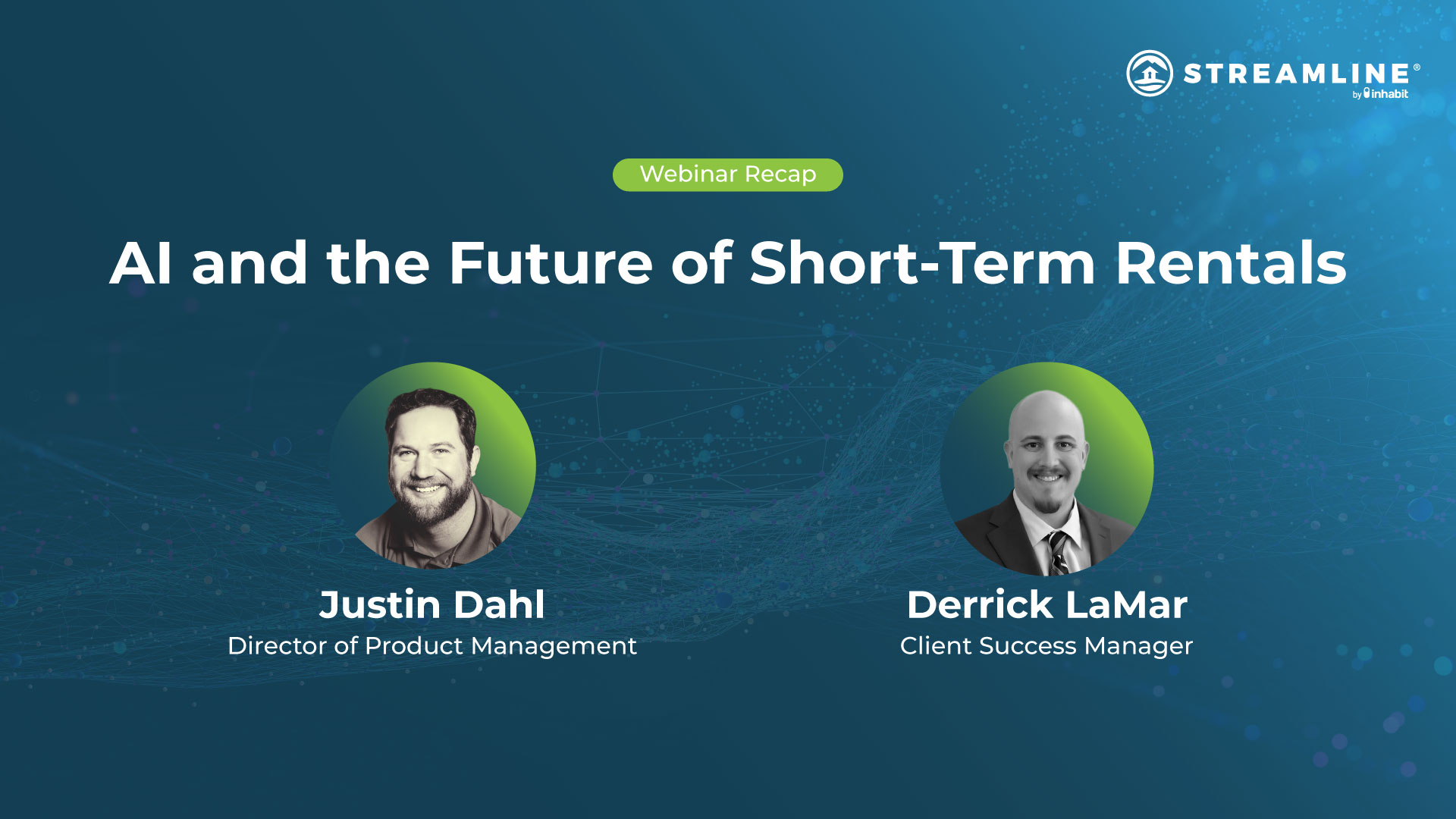
Artificial intelligence (AI) is no longer a future-facing concept for operators in the short-term rental industry. It’s already reshaping how travelers plan trips, how properties get discovered, and how property management teams handle day-to-day work. In our recent webinar, experts from the Stream Team explored how AI is changing the short-term rental industry—and what operators can do now to stay ahead.
Watch the full webinar to get every detail or read the recap blog below for a high-level overview.
AI Adoption Is Moving from Optional to Operational
The short-term rental industry has reached an inflection point, and AI is no longer something property managers are simply experimenting with between calls. About half of the industry was already on board by 2023, with 45% of STR operators using at least one AI tool; by 2025, that number had risen to 61%. Today, 72% of STR executives say they plan to increase their investment in AI tools over the next two years.
While there are endless use cases to support the implementation of AI tools, the reasoning boils down to one core idea: AI amplifies human efforts, empowering teams to accomplish more (without more labor).
One clear example is in the repetitive tasks that end up monopolizing your time. Every property manager knows that tasks like guest messaging, listing optimization, and data analysis can take hours when done manually. But with the right AI tools, those tasks can be completed more quickly and with greater consistency, freeing up valuable time for the other tasks on your never-ending to-do list.
Although many teams use AI to support their growth goals, this doesn’t mean AI will or should replace humans. Instead, the greatest opportunity lies in using AI to support existing teams so they can spend less time on repetitive work and more time on higher-value guest, owner, and operational priorities.
Travelers Are Using AI Too
One of the most important trends our Stream Team experts covered was a shift taking place before guests even connect with a property: travelers are increasingly using generative AI tools like ChatGPT to research destinations, compare properties, and build custom itineraries.
While search engines were previously the go-to for anyone looking to plan a trip, many travelers are opting out of the endless web results and getting straight to the point by telling an AI assistant exactly what they want. Instead of starting with a traditional search engine and filtering through pages of listings, guests may now ask an AI assistant for exactly what they want: a beachfront home that sleeps six, a property near specific attractions, a vacation rental with a private pool, or a stay that fits a particular type of trip. That changes the discovery process. AI systems are beginning to evaluate listings before travelers ever see them.
For property managers, this makes listing quality more important than ever. Clear descriptions, a comprehensive list of amenities, structured property data, availability details, reviews, and market-specific content all help AI tools understand what makes a property relevant. Webinar host Derrick LaMar summed it up perfectly:better information leads to better discoverability.
What Do You Know About GEO?
While SEO helps people find websites through traditional search, generative engine optimization, or GEO, helps AI systems understand and recommend properties in response to natural-language questions. A vague headline like “The Vegas Getaway” may sound appealing, but a specific headline—such as “modern three-bedroom Las Vegas vacation rental with private pool”—gives AI clearer signals about location, size, property type, and key amenities.
This doesn’t mean abandoning SEO. It means making content useful for both search engines and AI-powered discovery.
You can test this out for yourself by searching for vacation rentals in your market using an AI tool. If your properties are missing from the results—or competitors are recommended more strongly—ask why. The answer may reveal gaps in your descriptions, amenity details, reviews, or positioning.
Your AI Must Understand Your Business
AI is most valuable when it has context. Disconnected tools often require users to copy and paste data and re-explain their business to the AI, even for simple tasks. Integrated tools like Streamline’s Leo AI, however, connect AI directly to the information operators already manage inside their PMS, saving time and producing more reliable, comprehensive results.
The Brand Profile is another example of what integrated AI looks like in practice. By giving Leo the foundational knowledge of a company’s voice, markets, guest types, seasonal context, channel preferences, and AI writing preferences, operators can maintain a more consistent brand voice across listing content, guest communications, and other AI-assisted outputs.
The Listing Optimizer is another helpful tool for optimizing for GEO. It can update headlines, descriptions, and channel-specific content across one (or many) units while factoring in amenities, geographic context, brand guidance, and positive review themes—making key information clearer and more usable for both guests and AI systems.
AI Helps Make Sense of the Numbers
AI can also make operational data easier to navigate. Leo Insights, which we like to think of as an “ask anything of your data” tool, allows users to ask plain-language questions about reservations, balances, booking trends, geography, pacing, and more—without digging through multiple reports.
For example, an operator could identify upcoming reservations with positive balances, see where guests are booking from, or spot booking-window patterns that could inform promotions. Leo transforms the raw data into clear insights on the next steps to best suit your goals.
The Best AI Strategy Starts with a Clear Outcome
Don’t use AI just for the sake of using AI. Be mindful of your desired outcome when prompting AI tools. Asking AI to “analyze the last 12 months” will likely produce a broad or lengthy answer; but asking it to “identify units with short booking windows to help target early-booking promotions” will produce much more actionable results.
The same principle applies to guest communication, listing optimization, reporting, reputation management, and owner-facing insights. AI works best when it’s tied to a defined business need and supported by accurate, relevant data.
Ready to See What Smarter Property Management Could Look Like?
If your current systems make it difficult to keep listings consistent, uncover insights, or scale efficiently, it’s time for a more connected approach. Streamline brings property management, guest communication, reporting, distribution, and AI-powered tools together in one platform built for short-term rental operators.
Book a free demo with our experts to see how your team can work more efficiently, improve property visibility, and prepare for the next era of AI-powered vacation rental management.